


Squash, animal behaviour, and the desperation threshold
I recently started playing squash - a fun, fast, and strategic game. I hadn’t played before, and it took a while to get used to the rules and format, especially the low bounce of the soft rubber ball.
Soon, as with anyone who starts playing a sport, I felt myself getting better - I could now return the ball most of the time and even place the occasional drop shot. To invite more people into the game, a squash ladder was organised at Queens' College – giving people the platform to play one another.
Surprisingly, I started winning a few of these matches.
I thought of why this was, I was certain that it was not my acumen or skill, but somehow I still managed to win, or at least give a close fight to more experienced players. How did this happen?
My PhD revolves around decision-making for wildlife conservation — what drives people to do what they do, and also, importantly, what stops people from doing what they want to be doing?
This means drawing on theories about human behaviour, psychology, and economics and combining them with ecology and conservation science — to understand and test ‘what works’ to improve outcomes for people and wildlife, like helping humans and elephants share spaces safely.
There are three insights from these fields that I think can explain my trajectory in squash, and why I seemed to be having better outcomes than expected. Here, I club human and non-human animals together under animals, as this reflects the context of the article, and our shared evolutionary history.

Why animals lie to themselves
We animals lie. This is a well-established principle in ecology, and the benefits of these are obvious — you can access more resources at lesser cost to yourself. For instance, a friend recently told me that he figured the moment his daughter learned to lie about who ate the cookies, much like a less dominant monkey giving a false alarm call about a predator to divert the dominant male’s antagonistic attention from himself, to an outside threat.

A young stump-tailed macaque
However, what remained a question in evolution for several decades was why do animals lie to themselves about their own abilities, ie, engage in self-deception. For instance, a young chimpanzee truly acting that it can take on the older dominant male and hence signalling accordingly, or a weaker crab choosing to display more aggressively during a territorial fight. Evolution is not supposed to care about what you think, but about what you do — so how does one reconcile self-deception with the broader theory of evolution? This remained unexplained for close to a century, until Robert Trivers’ work in the 1970’s.
His pioneering work formulated how self-deception could have evolved, making the case that animals lie to themselves so that they can deceive others more effectively. I quote him from a foreword he wrote to the evolutionary scientist, Richard Dawkins’ book, The Selfish Gene:
“If (as Dawkins argues) deceit is fundamental to animal communication, then there must be strong selection to spot deception and this ought, in turn, to select for a degree of self-deception, rendering some facts and motives unconscious so as not to betray – by the subtle signs of self-knowledge – the deception being practiced” (1976)
In other words, if you truly believe your own lie, your opponent won't detect the lie hidden in other cues, like your body language.
Now how does this relate to my squash game?
I am well-aware of my limited skills in the game; however, a lot of the game depends on how well the opponent predicts and therefore pre-emptively responds to my shot — for instance, if he thinks that I will be playing a drop shot, he can quickly move to the top of the court and be perfectly positioned to return my volley. He can get an intuitive clue of this from the way I lift up my racket, the movement of my feet, and general body language.
However, in my case, this is rendered useless because even I don’t know what shot I am eventually going to play — not out of choice, but rather, the lack of ability to play it! This, I think, confuses the mental models of my opponents and I win more points than merited by skill alone.
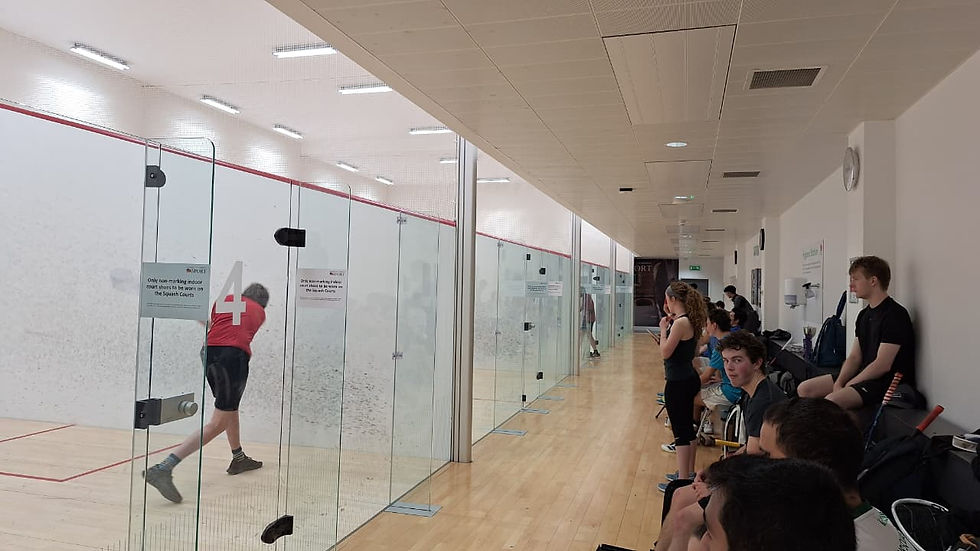
Cuppers squash tournament
The power of novel strategies
I came to represent my College, Queens’ in the annual Cuppers tournament, an intra-university championship - by quite a stroke of accident, filling in for an injured player. The level of the game at this platform is very high, well above my novice stage. I knew this, and was looking to play a good and fun game, better than a walkover in any case.
Opposite me was an excellent player with several years of competitive experience under his belt, evidenced by his warm up shots which were perfectly placed against the well. Nonetheless, our game began, and much to everyone’s (and very much my) surprise, I narrowly lost, 11-8 in the first round. I attribute this entirely to the lack of predictability of my game, and this being a ‘novel’ strategy. Therefore being unable to foresee and plan for, much like how a gazelle runs from a cheetah, looping, zig-zagging, and bouncing in unpredictable ways. However, the novelty wore off very soon in this case, and my opponent beat me in no time, winning the game.

The Desperation Threshold Model
Cass Sunstein writes that one has a plethora of options for the most common question in squash; “play it safe, or take a risk?”. Should I go to the front of the court and attempt a hard smash that the opponent has little chance of returning, or should I take a more moderate stance at the centre of the court and try to keep returning the ball?
This is analogous to one of the most important questions in applied development and conservation action: How does poverty impact decision-making? Should I take a risk with what I have to get more, or should I be more prudent?
The outcomes are mixed, with some people becoming very averse to risk and playing it safe, and at other times, becoming very risk-seeking, in response to poverty. This is a critical factor to keep in mind when designing interventions, as people would react to incentives differently in each scenario. For instance, risk seekers may put less weight on the probability of getting caught, while risk-averse individuals may avoid an action altogether even when the odds are overwhelmingly in their favour.
De Courson et al., find that this fits a pattern they describe as the Desperation Threshold Model; when people are just above their basic needs, for instance, enough for food and shelter, they tend to avoid risks. But when they fall below that point, such as after a disaster or losing social support, they may take bigger chances, like risky bets or committing crimes. For example, homeowners who suffer losses in a flood are more likely to gamble afterward, and crime rates often rise as welfare payments run out.
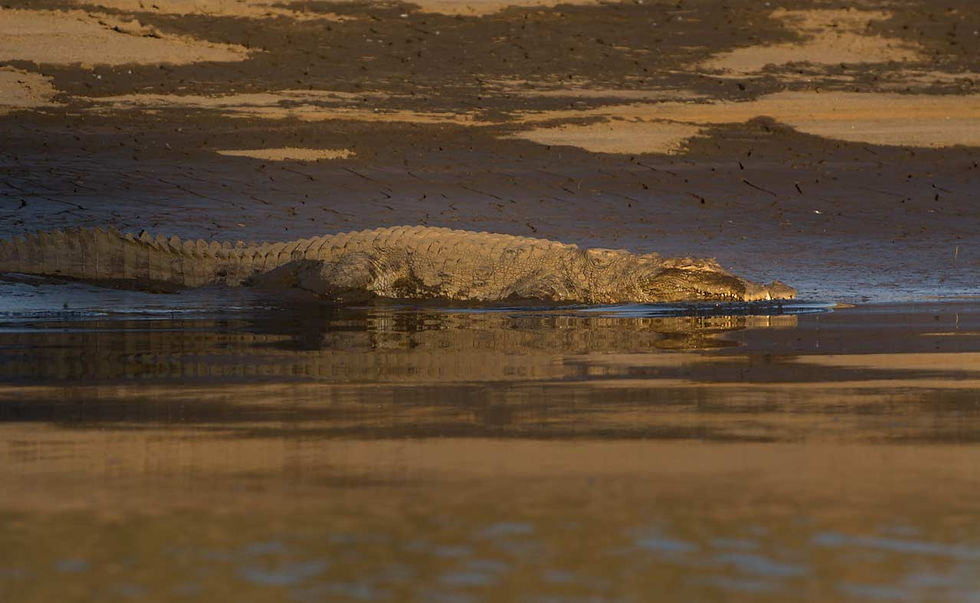
In ecology, this is called the ‘risk-sensitive foraging theory’, which says that when animals face a very real threat of starvation, they would take any level of risk to obtain food, eg. a wildebeest approaching a waterbody full of crocodiles during a drought. Once a certain threshold of security has been obtained, they would steer clear of these excessive risks.

I see this play out in our games; the winner is the first one to reach 11 points.
If Rafa, my opponent, is beating me by a large margin, for instance 2-8, I tend to take a more ‘high-risk, high-reward’ stance by moving to the front of the court or attempting a hard shot. This can enable me to win a few quick points, with the worst case being me losing, which is almost certain anyway.
The most striking part of this is how these decisions are happening at a subconscious level, with me not explicitly aware that I am making these tradeoffs. This is probably similar to wild elephants in India taking a similar high-risk, high-reward strategy and eating people’s crops that are high in nutrition, but also bear the possibility of lethal action from the farmers — all the more relevant in the face of massive habitat loss, which is probably unable to support the particular population of elephants.
Perhaps the broader point here is that decisions have to be seen in the context in which they are made; whether ecological, economic, or in squash.


Comments