


Fish farts, dead elephants, and total institutions in wildlife conservation
Updated: Jul 22
This article was spurred by Adam Mastroianni's 2026 Experimental History Blog Post Competition, Extravaganza, and Jamboree! which is a nudge to finish unpublished pieces and put them out onto the internet. This piece won an honourable mention.

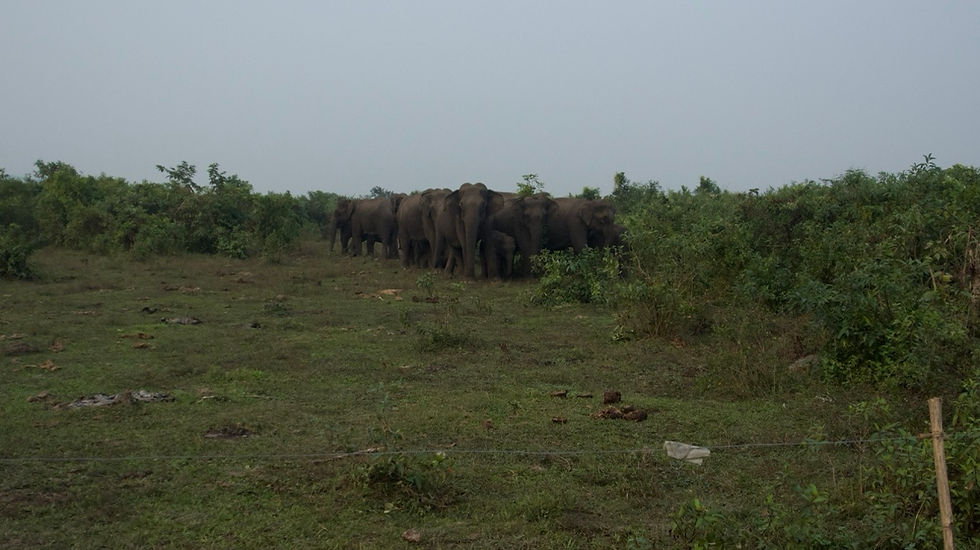
A single strand of barbed wire separates an army camp from a row of mud-walled houses in India's far northeast. Every few days a group of bull elephants walks out of the forest and straight through both.
This is not unusual. Most of India's wildlife lives outside the national parks and reserves we think of as "protected", rather, thriving in landscapes shaped and shared by people. Leopards moving through factories, tigers in sugarcane fields, snakes in cites, and elephants in paddy fields are all commonplace in the country. This means that their survival is dependent on how people think, feel, and act with wildlife around them.
My work as an applied conservation scientist brings me in contact with many different people, including farmers, railwaymen, politicians, schoolteachers, administrators, and recently, the army. Though there is a large variability in how these different people work, think, their motivations and pains -- there is still a familiarity that almost all individuals share with one another. This stems from an implicit, shared set of realities and everyday experiences.

However, the armed forces are the exception. Owing to their rigorous training, they constitute what sociologists call a 'total institution'. This is a world where a group of individuals are kept physically and socially separated from the larger world, interacting primarily amongst themselves and are often highly monitored by a hierarchical system. Examples include cults, mental asylums, and prisons.
These conditions lead to an individual’s sense of reality being moulded almost entirely by their immediate context, and therefore a reduced ability to understand how the world outside their boundaries works. This is not necessarily a detriment because total institutions are an excellent place for building trust amongst unrelated individuals, especially in stressful situations where a strong social order is the most efficient. However, this immersion also bears the risk of removing one from the realities shared by most of the population.

Elephants break into a house searching for rice wine, salt, or grain

A band of four male elephants are notorious for these damages
I watched this play out at one site in the northeast of India. As the elephants pass through, they sometimes break into a house after stored grain, salt, or rice beer — a fairly new and recurring habit, spurred by deforestation nearby.
These kinds of damages occur in both, the village as well as the army camp. However, their responses are worlds apart. The villagers recognise the aspect of elephants needing to move through, and are quick to find ways to adapt – such as keeping attractants away from the elephants’ path and leaving a strip of land for them to move.
The army, on the other hand, refuses to recognise this. Despite their damages being miniscule, and the consequences being borne by the State and not the individuals themselves, the army officers often respond with wanton callousness - their wilful negligence having led to the electrocution of an elephant within their premises just this week. A sagging electricity wire came into contact with a young tusker, leading to his demise.

An elephant electrocuted by a sagging wire
Despite direct directions from the wildlife authorities and a Supreme Court ruling prohibiting the use of iron spikes embedded in the ground to deter elephants, the army continues to use these. These sharp, six-inch long spikes merge with the ground and impale the feet of passing elephants, often leading to a slow and painful death days or weeks later because of infections caused by these injuries. When spoken with, the army insists that they are free to do what they please as it is ‘not the job of civilians to advise them’.
The most telling of this high-handed callousness is their rejection of a simple and effective solution that already exists and has proven to be highly effective, one used world over -- a non-lethal electric fence. This works by giving the elephants a harmless but highly uncomfortable shock, thus creating a psychological barrier for the elephants, and keeping them out of the fenced area. This is more effective, less expensive, and safer than any of the methods that the army currently uses to reduce elephants from coming in.
The army doesn’t adopt this because they believe that they know best and do not require recommendations from civilian institutions. Multiple rounds of conversations have led nowhere. Wildlife authorities, scientists, and conservationists have all tried and failed repeatedly.
A single-strand non-lethal electric fence successfully keeps elephants away
These patterns are not restricted to the Indian armed forces, but are symptomatic of total institutions across the globe. Being immersed within, and as a result exposed only to one's peers, especially in a hierarchical system can lead to the false belief that one is an expert on everything.
For instance, the armed forces of Sweden, for over a decade in the 1980s were bombing the living daylights out of their coasts because they were certain that what they heard through their acoustic sensors in the water were Soviet submarines. Millions of dollars, bombs, and efforts were spent to combat this insurgency. To verify that these sounds were indeed submarines, they also used SONAR imaging - where they saw one submarine splitting up into two, then into four, and then rejoining into one once again. Their military engineers were instructed to spend their efforts to build models of how these super-sophisticated submarines of the Soviets worked, and potentially replicate this technology.
Much later, spurred by the end of the Cold War not leading to these alleged submarines disappearing, and Russian president Boris Yeltsin denying the deployment of any submarines, the Swedish armed forces approached ecologists working on marine sounds. They quickly figured out that these sounds were only shoals of the herring fish releasing gas from their butts. This, of course, led to the severe embarrassment of the army that had been bombing these so-called submarines for years, costing the public exchequer millions of dollars.
Similarly, real conservation occurs within human institutions such as bureaucracies, militaries, and corporations. The success or failure of conservation often depends less on ecological knowledge than on how these institutions are willing to consider the many perspectives and insights when confronting a challenge. The armed forces ought to realise that power may flow from the barrel of a gun, but logic does not. If it does not wish to be embarrassed by fish-farts or dead elephants, then it should probably open its ears and mind to collaborations beyond its total institution.

Local children skipping school to watch elephants in their backyard

Sharing space with wildlife is part of life in these systems


Comments